
The Benefits of Sustainable Interior Design by Kate and Mark Interiors


Your home shapes how you feel every single day. The air you breathe, the light that reaches you, the textures around you — all of it adds up. Sustainable interior design is not a trend. It is a smarter, healthier, and more responsible way to build the spaces you live and work in. At Kate and Mark Interiors, one of the leading interior designers in Kochi, this philosophy sits at the heart of every project.
Here is a close look at what sustainable interior design actually means, why it matters, and how Kate and Mark bring it to life across homes and commercial spaces in Kerala and beyond.
What Sustainable Interior Design Actually Means
Sustainable interior design is the practice of creating beautiful, functional spaces while minimizing harm to the environment and maximizing benefit to the people who use them. It covers everything from the materials chosen for flooring and furniture, to how a room is oriented for natural light, to the paints used on the walls.
It is not about sacrifice or compromise. Done well, a sustainable space is often more comfortable, more durable, and more visually stunning than a conventional one. The key is in the choices — materials, sourcing, craftsmanship, and design strategy — all working together.
Kate and Mark Interiors, headquartered in Aluva, Kochi, has built its entire practice around this idea. With in-house furniture and interior factories, the team controls the full chain from sourcing to delivery, which means every material decision is intentional and verifiable.
Benefit 1: Cleaner Air Inside Your Home
Most people assume outdoor air is more polluted than indoor air. Research tells a different story. Indoor pollutant levels can run 2 to 5 times higher than outdoors, largely because of the materials used inside our buildings — synthetic paints, adhesives, particleboard furniture, and synthetic textiles all release volatile organic compounds (VOCs) over time.
Sustainable design addresses this at the source. Kate and Mark use low-VOC and non-toxic paints and finishes throughout their projects. Flooring choices like cork and bamboo replace synthetic alternatives that off-gas for years. Organic cotton and hemp textiles are used in upholstery and soft furnishings instead of synthetic blends treated with chemical coatings.
The result is a home where the air is genuinely cleaner. For families with young children, elderly members, or anyone with respiratory sensitivities, this is not a small detail — it is a meaningful upgrade to daily quality of life.
Benefit 2: Lower Energy Bills and Smarter Spaces

Kerala's climate is warm and humid for most of the year. Conventional interiors often fight this with energy-intensive air conditioning. Sustainable design works with the climate instead of against it.
Kate and Mark's climate-responsive approach focuses on natural ventilation paths and strategic window placement. When rooms are designed to catch prevailing breezes and channel natural light effectively, the dependence on mechanical cooling drops significantly. Energy-efficient designs like these can cut monthly utility costs by up to 30%, according to industry research.
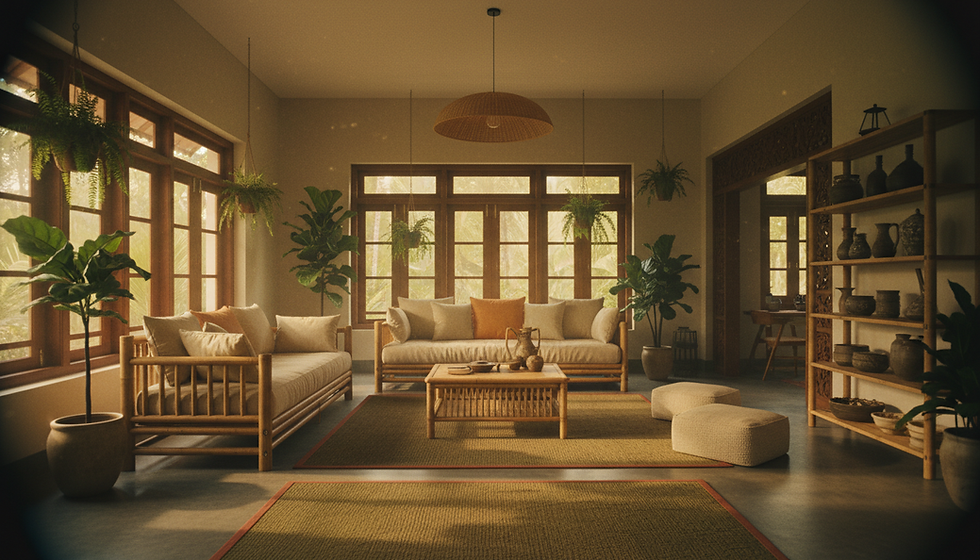
Beyond ventilation, the team incorporates biophilic elements — indoor greenery, water features, and natural textures — that have a measurable cooling effect on perception. A space that feels cooler and more connected to nature genuinely reduces the impulse to reach for the thermostat.
Benefit 3: Materials That Last Longer and Cost Less Over Time
One of the most overlooked financial arguments for sustainable design is durability. Cheap, fast-furniture tends to warp, peel, and fall apart within a few years. When you factor in replacement costs, the economics of buying low-quality materials rarely hold up.
Kate and Mark's furniture, produced in their dedicated factory in Aluva, uses solid bamboo and premium handcrafted wood. These materials are not just environmentally sound — bamboo regenerates far faster than conventional timber — they are genuinely built to last. Cork flooring, another material the team favors, is resilient, naturally antimicrobial, and comfortable underfoot for decades.
The industry term for this shift is "specifying for lifespan." Instead of designing for a trend cycle, the goal is to create spaces that age beautifully and need minimal replacement. Furniture waste is a serious problem — roughly 12.1 million tons are discarded every year globally, with 80% going to landfill. Choosing materials designed to last is one of the simplest ways to step out of that cycle.
Homes with green design features also carry a market value premium of around 10%, which means sustainable choices protect your investment in a very practical sense.
Benefit 4: Better Mental Well-Being and Comfort

The connection between the spaces we inhabit and how we feel mentally is well established. Research shows that people in spaces designed with natural elements report a 15% increase in well-being and a 6% increase in productivity. Natural light alone — when properly incorporated into a design — regulates circadian rhythms, lifts mood, and improves sleep quality.
Biophilic design is the practice of weaving nature into interior spaces. Kate and Mark apply this through indoor plants, natural light maximization, water features, and the use of organic textures like wood grain, stone, and woven fibers. These elements do not just look good — they actively reduce stress and mental fatigue.
In Kerala's context, where lush greenery and natural beauty are part of the landscape, this approach feels especially intuitive. Interiors that reflect the natural world outside tend to feel grounded, calm, and genuinely restorative. This is particularly valuable in bedrooms and study spaces, where rest and focus matter most.
Benefit 5: A Reduced Environmental Footprint
Buildings are responsible for 37% of energy-related CO2 emissions globally. Interior design is not separate from that figure — every material specified, every finish applied, and every piece of furniture chosen has an environmental cost attached to it.
Sustainable design reduces that footprint across multiple fronts. Local sourcing cuts transport emissions and supports regional craft traditions. Natural materials like cork, bamboo, and rattan are renewable and biodegradable. Choosing low-VOC paints and FSC-certified timber removes harmful chemicals and irresponsible logging from the supply chain.
Kate and Mark's end-to-end manufacturing model, with both interior and furniture factories operating in Aluva, gives the team direct oversight of how things are made. That control means fewer corners cut on material quality or environmental standards — which is exactly what distinguishes a genuinely responsible design practice from one that simply uses sustainability as a marketing label.
How Kate and Mark Interiors Brings It All Together
As one of the best interior design companies operating out of Kochi, Kate and Mark Interiors brings a rare combination of design vision, manufacturing capability, and environmental commitment to every project.
Their process starts with understanding the site — its orientation, wind patterns, existing natural light, and the client's lifestyle. From there, material choices are made deliberately, with sustainability criteria built into every decision rather than added as an afterthought.
The team's experience centers in Aluva, Thrissur, and Bangalore give clients across South India the ability to see, touch, and experience materials in person before committing. That tactile dimension matters when you are choosing between a cork floor and a bamboo one, or selecting an organic cotton weave for your living room sofa.
Whether the project is a private home, a corporate office, or a hospitality space, the principles remain the same: design spaces that are healthy for the people who use them, respectful of the environment, and built to endure.

Making the Switch to Sustainable Design
You do not need to redesign your entire home to start making more sustainable choices. Many clients begin with a single room — a bedroom makeover using natural textiles and low-VOC paint, or a living room refresh anchored by a solid bamboo furniture piece. The approach scales naturally from there.
What matters is working with interior designers in Kochi who understand both the design possibilities and the material science behind sustainable choices. Greenwashing is common in the industry — products are frequently marketed as "eco-friendly" without meaningful certification or transparency. A credible design partner helps you navigate that noise and make choices that actually deliver on their claims.
Kate and Mark's commitment to in-house manufacturing and direct material sourcing is part of what sets them apart as a best interior design company for clients who want accountability alongside aesthetics.
The Bottom Line
Sustainable interior design is good design. It produces spaces that are healthier, more comfortable, more energy-efficient, and more visually cohesive than spaces built without those principles. The environmental benefits are real and measurable. So are the financial ones.
Kate and Mark Interiors has spent years proving that sustainability and beauty are not competing priorities — they are the same goal, approached thoughtfully. If you are planning a new home or renovation in Kochi or across Kerala, it is worth starting the conversation with a team that treats every material choice as an opportunity to do better.
Reach out to Kate and Mark Interiors at their experience center in Aluva or visit one of their showrooms in Thrissur or Bangalore to see sustainable design in action.


Comments