
How to Plan a Green Interior Design Project in Ernakulam

By Kalte & Mark Architects and Interiors | Best Interior Designers in Aluva–Kochi
Ernakulam is not the easiest place to design for. The humidity is relentless, the monsoon is unforgiving, and the sun hits hard from the west every afternoon. But those same conditions that make design challenging also make the case for green interiors impossible to ignore. A well-planned eco-friendly home in this climate does not just look good — it performs better, costs less to run, and holds up longer.
This guide walks you through every stage of planning a green interior design project in Ernakulam, from your first brief to your final finish selection.

Step 1: Start With a Clear Green Brief
Before you pick a single tile or paint color, define what "green" means for your project. The term covers a wide spectrum — from simply switching to LED lighting, to building with rammed earth walls and harvesting rainwater. Knowing where you sit on that spectrum shapes every decision that follows.
A useful starting point is to answer three questions:
What is your sustainability priority — materials, energy, water, or all three?
What is your budget, and how much of it can go toward long-term investments like solar or high-performance glazing?
Are you renovating an existing space or designing from scratch? The answer changes your options significantly.
Once you have those answers, share them with your designer in writing. A vague brief leads to generic outcomes. The more specific you are, the more your home will reflect your values — and Ernakulam's character.
Step 2: Respect the Climate First
Ernakulam sits on Kerala's coast. That means two things above all else: heat and humidity. Any green design strategy that ignores these realities will fail on both comfort and sustainability grounds. The goal is to let the building do the work before you reach for the air conditioner.
Traditional Kerala architecture figured this out centuries ago. The Nadumuttam — the central open courtyard — acts as a natural ventilation engine, pulling hot air upward and drawing cooler air in from the sides. High ceilings with ventilators at the top serve the same principle: the stack effect. Shaded verandas, or Poomukham, block direct sun while keeping the home open to breezes.
Modern green interiors in the region adapt these ideas rather than abandon them:
Place larger windows on the north facade for consistent, glare-free light without heat gain.
Limit west-facing openings to reduce the brutal afternoon heat load.
Use Low-E (low-emissivity) or double-glazed windows where glass is essential — they cut heat transfer without blocking light.
Apply white reflective roof coatings or insulated roofing panels to reduce cooling loads, which account for up to 40% of household energy use in Kerala.
Getting this right means your home stays comfortable with less mechanical cooling — which is both greener and easier on your electricity bill.

Step 3: Choose Materials That Belong Here
The most sustainable material is usually the one closest to you. Shipping Italian marble halfway around the world to place it in a Kochi living room adds a carbon footprint before the first guest walks in. Ernakulam and the surrounding region offer some of the richest material traditions in India — and most of them perform beautifully in humid, tropical conditions.
Here is what to consider for each part of your home:
Flooring
Athangudi tiles — handmade clay tiles from Tamil Nadu, naturally cool underfoot, zero chemical processing, and visually stunning.
Bamboo flooring — renewable, hard-wearing, and resistant to warping when properly treated.
Coconut wood — a byproduct of aged coconut palms that are no longer productive. Durable, dense, and locally abundant.
Walls and Structure
Laterite stone — naturally porous and cool, quarried widely across Kerala, and excellent at regulating humidity.
Lime-based plaster — allows walls to breathe, which prevents mold in Ernakulam's high-humidity environment.
Reclaimed teak and rosewood — sourced from old Kerala homes undergoing demolition. Richer in grain, more durable, and zero new deforestation.
Furniture and Soft Furnishings
Rubberwood — a plantation byproduct harvested after rubber trees stop producing latex. Affordable, renewable, and widely available in Kerala.
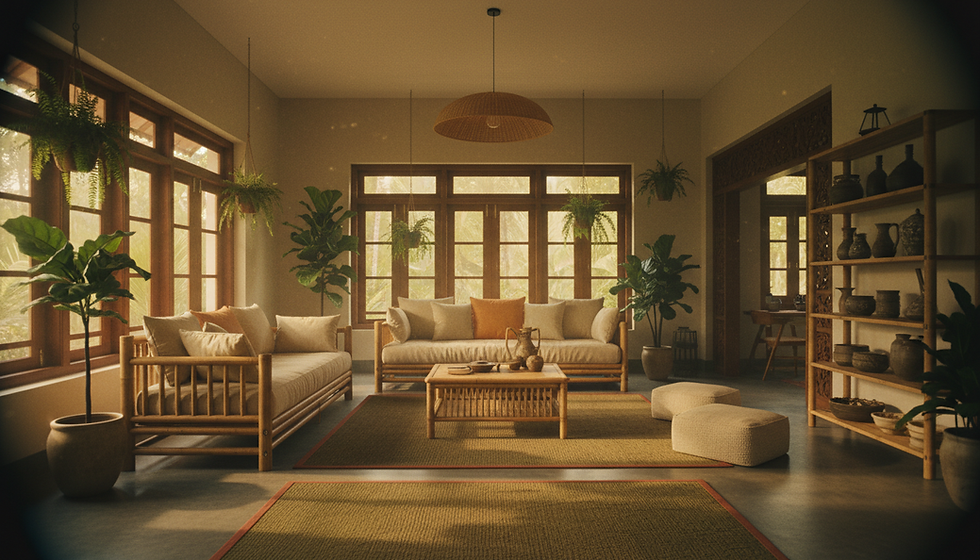
Rattan and cane — lightweight, breathable, and perfect for a tropical aesthetic.
Coir and jute — for rugs and upholstery, both are natural, biodegradable, and locally produced.
Paints and Finishes
Low-VOC (volatile organic compound) paints — standard paints off-gas chemicals for months after application. Low-VOC alternatives are widely available and significantly better for indoor air quality.
Natural clay plaster — a traditional finish that regulates moisture and stays cool to the touch.
Step 4: Design for Energy Efficiency
Materials set the foundation, but how your home uses energy day-to-day is where the long-term impact lives. Green interior design in Ernakulam treats energy efficiency as a design constraint from day one — not an afterthought.
Lighting
Switch entirely to LED lighting — LEDs use 75% less energy than incandescent bulbs and last up to 25 times longer. Add occupancy sensors in rooms like bathrooms, storerooms, and corridors where lights are frequently left on accidentally. Dimmers reduce consumption by a further 20–30% and extend bulb life.
Smart Home Systems
Ernakulam has a growing number of local smart home providers. Automated climate control — where the system adjusts cooling based on occupancy and natural light — can cut energy use noticeably. This is not luxury technology anymore. Entry-level smart thermostats and lighting controllers are now accessible at most price points.
Solar Integration
Kerala receives strong sunlight across most of the year outside monsoon season. Rooftop solar panels, paired with a net metering arrangement through KSEB, can offset a significant portion of your electricity costs. If you are designing from scratch, factor in roof orientation and shading from nearby trees at the planning stage.
Water Systems
Ernakulam receives over 3,000 mm of rainfall annually. Rainwater harvesting is not just eco-friendly here — it is practical. Simple collection systems connected to storage tanks can supply water for toilets, irrigation, and general cleaning. Pair this with low-flow fixtures in bathrooms and kitchens for a complete water-efficient setup.
Step 5: Bring Nature Indoors with Biophilic Design
Biophilic design is the practice of incorporating natural elements into interior spaces — and in Ernakulam, the raw material is right outside your door. The goal is not decoration. Plants, natural light, and natural textures have measurable effects on air quality, stress levels, and overall wellbeing.
For air quality specifically, a few indoor plants go a long way. Areca palms are one of the most effective natural air humidifiers — useful in air-conditioned rooms that dry out quickly. Snake plants and Peace lilies filter toxins like formaldehyde and benzene, which off-gas from synthetic furniture and paints. Even a simple arrangement of potted plants near a window creates a biophilic moment without major cost.
Beyond plants, biophilic design includes using natural textures (stone, wood grain, woven cane), maximizing views to outdoor greenery, and letting in natural light at multiple points throughout the day. These choices cost nothing extra when planned from the start.

Step 6: Work With the Right Designer
Green interior design is not something you can bolt on at the end of a project. The decisions that matter most — orientation, ventilation, materials sourcing, energy systems — are made in the earliest phases. That means the designer you choose matters enormously.
When you search for home interior designers near me in Ernakulam, you will find many options. But not all of them think in systems. A truly green designer asks questions before presenting mood boards: How does the house sit on the plot? Which way does the prevailing wind come from? What materials are available within 100 km? What is your long-term energy plan?
Ask potential studios to walk you through a past green project. Ask about their material sourcing process. Ask whether they work with local artisans and tradespeople — because in Ernakulam, that expertise exists and it produces better results than importing solutions from elsewhere.
At Kalte & Mark, our work is rooted in what we call Neo-Vernacular design: traditional Kerala spatial principles, applied with contemporary materials and green technology. We work primarily across Aluva and Kochi, and every project we take on starts with the same question — what does this site need, and what does this climate ask of us?
Step 7: Budget Realistically for Green Design
One of the most persistent myths about sustainable interiors is that they cost significantly more. In Ernakulam, that is not always true. Local materials like laterite stone, coir, rubberwood, and Athangudi tiles are often competitively priced against imported alternatives. The savings come from sourcing within the region rather than outside it.
Eco-friendly interior design in Kochi typically ranges from INR 500 to INR 2,500 per square foot, depending on the complexity of materials and the scope of the project. The higher end of that range usually involves premium reclaimed materials, custom craftsmanship, or integrated smart home systems.
Where green homes do cost more upfront is in energy systems — solar panels, high-performance glazing, rainwater harvesting infrastructure. Think of these as investments. A solar system in Kerala typically pays for itself within 5 to 7 years and then runs essentially for free for another decade or more.
When planning your budget, separate it into two categories:
Operating cost reductions: energy and water systems with long payback periods but clear returns.
Material and design choices: where local and sustainable can often match or beat conventional pricing.
Step 8: Plan for the Long Term
Green design does not end at handover. A sustainable home needs to be maintained the same way it was built — with care for materials, systems, and the environment around it.
Natural materials like lime plaster, untreated wood, and coir require periodic maintenance. Lime walls may need refreshing every few years. Wooden surfaces in humid environments benefit from annual treatment with natural oils. These are small commitments that preserve both the character of the space and its environmental credentials.
Energy and water systems need periodic inspection — solar panels should be cleaned regularly, and rainwater filters replaced seasonally. None of this is demanding, but it does require a homeowner who is engaged with their home.
The reward is a home that ages gracefully, improves in character over time, and continues to perform efficiently for decades.

The Takeaway
Planning a green interior design project in Ernakulam is not about following a checklist. It is about making decisions that are specific to this place — its climate, its materials, its building traditions, and its people. The best outcomes come from treating sustainability not as a constraint, but as a creative brief.
Start with a clear intention. Choose materials that belong here. Design for the climate, not against it. Invest in energy and water systems that pay you back. And work with designers who understand Ernakulam well enough to know that the answers are usually already here — they just need to be uncovered.
Ready to start your green interior project in Ernakulam?
Kalte & Mark Architects and Interiors are among the best interior designers in Aluva–Kochi, specializing in sustainable and Neo-Vernacular design for Kerala homes. Get in touch with us to plan a space that works with your climate, your culture, and your values.


Comments